How to count days between two dates, and whether to count the first day
The formula for days between dates, when to add 1 for counting both ends, how deadlines like "within 30 days" are counted in the US and the UK, and a table of common cases from hotel stays to whole years.
Oct 19, 2026 · By Calcelate Team
The short version: subtract the earlier date from the later one. That counts the days between the dates, and it does not count the first day. If both the first and the last day should count, add 1. Almost every disagreement about “how many days” comes from mixing up these two answers.
What is the formula to count days between two dates?
days between = end date − start date
From Monday to Wednesday is 2 days. From March 1 to March 31 is 30
days. In Excel or Google Sheets, with the start date in A2 and the end
date in B2, =B2-A2 gives the same number, and so does
=DAYS(B2,A2).
Note the order: DAYS takes the end date first.
When the dates are in different months, you do not need to know how long each month is if you use a calculator or a spreadsheet. By hand, count the days left in the first month, add the full months in between, then add the days in the last month.
Run the numbers yourself
Date calculator
How many days are inclusive between two dates?
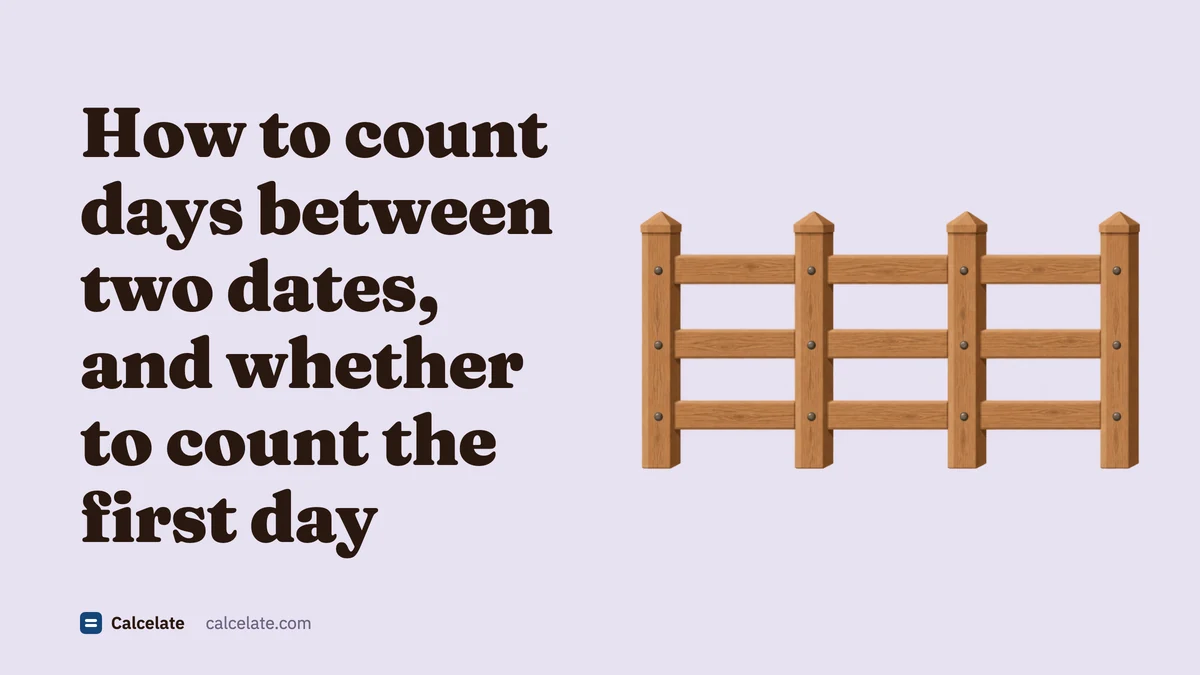
Add 1 to the difference. “Inclusive” means both the first and the last day are counted, so the answer is always one more than the plain difference. It is the same as the old fence-post puzzle: a fence with 10 sections has 11 posts. The sections are the days between; the posts are the days you count when both ends are included.
Days between dates, with and without the end date
show
Weekdays are Monday to Friday; public holidays are not taken out. Each number is what the date calculator returns for those two dates.
The hotel row shows why both answers are useful. From check-in on June 10 to check-out on June 14 is 4 nights, which is what you pay for. But you are there on 5 different days, which is what matters for a parking pass or a day ticket.
The table also answers a common question directly: April 1 to June 30 is 90 days, or 91 days inclusive. That is the same every year, because February is not in the range. For ranges that include February, leap years add a day, as the February rows show.
When counting days, do you count the day you are on?
Usually not. “30 days from today” means today is day 0 and tomorrow is day 1. Thirty days from March 1 is March 31, not March 30.
Courts use the same rule and write it down. In US federal courts, Rule 6(a) of the Federal Rules of Civil Procedure says to exclude the day of the event that starts the period, count every day after it, including weekends and holidays, and include the last day. If the last day falls on a Saturday, Sunday or legal holiday, the period runs until the end of the next day that is not one. So a 30-day period that starts on Monday, March 1, 2027 ends on Wednesday, March 31. One that starts on Thursday, March 4 would end on Saturday, April 3, and so it moves to Monday, April 5.
State courts, contracts and government agencies can use different rules. When a deadline matters, read the rule that applies to it.
In the UK, the civil courts in England and Wales count many periods in “clear days” under rule 2.8 of the Civil Procedure Rules. Neither the day the period starts nor the day of the event at the end is counted. A notice that must be given 7 clear days before a hearing on the 15th has to arrive by the 7th: the days from the 8th to the 14th are the 7 clear days. For periods of 5 days or less, the rule also leaves out weekends, bank holidays, Christmas Day and Good Friday.
Business days
Business days are Monday to Friday. A plain count does not know about public holidays, because they differ by country and even by state, so subtract the ones that fall in your range. The last column of the table counts weekdays with both ends included: a whole year has 260 to 262 of them, depending on which weekday it starts on and whether it is a leap year.
Days from a date
To find the date N days after a start date, add N and do not count the start day. The date calculator does this in its “Add or subtract” mode and shows the weekday of the result. Under the result it also lists the dates 7, 10, 14, 30, 60, 90 and up to 365 days after and before the start date. For birthdays and ages, where months matter more than days, use the age calculator.
Calculators used in this article
- Date calculator
Count the days, weeks, months and business days between two dates, or add and subtract days, weeks, months or business days from a date to find the result and its weekday.
- Age calculator
Calculate your exact age from your date of birth, or the age on any date. See age in months, weeks, days and hours, the weekday you were born, and your next birthday.
By Calcelate Team. Sources are linked in the text and on the calculator pages.
- 2026-10-19 · Published